Wednesday, September 22, 2021

Sindh tells authorised officers to 'take keen interest' in checking vaccination cards


Sindh tells authorised officers to 'take keen interest' in checking vaccination cards


Sindh Home Department has  directed authorised officers to "take a keen interest" in ensuring that the citizens carry vaccination cards.

According to a notification, "carrying of vaccination cards at different places across the province had been made mandatory and inspection of vaccination cards had been entrusted to the Law Enforcement Agencies" in the order dated September 15, 

It has been observed that the divisional, district administration, and LEA personnel were not taking interest in checking  the citizens' vaccination cards, and no legal action or fine was being imposed over a violation of orders, the notification said. 

Therefore, in a bid to ensure the implementation of orders, "worthy Sindh chief secretary has directed the authorised officers and law enforcement personnel to take a keen interest in checking the vaccination cards of the concerned persons, and the violators must be taken to task under the law as authorised in the above-mentioned order". 

It further stated that these actions against the violators may be reported to the Home Department and chief secretary via deputy secretary on a daily basis by 10pm, for their performance to be judged.

The notification made the aforementioned instructions a "top most priority" for the concerned officials.

Moreover, a copy of the earlier order was also attached with the current directives, according to which, certain coronavirus-related restrictions in Sindh in pursuance of National Command and Operation Centre guidelines are to be followed starting September 14.

The guidelines and restrictions are as follows:

  • All the trade and business activities will be allowed to function till 10pm.
  • Essential services, such as pharmacies, medical stores, other medical facilities, and vaccination centres; petrol pumps, CNG stations, LPG shops; tandoors, and milk shops, are exempt from the restricted timings and will function 24 hours a day for the entire week.
  • All services and activities allowed to operate will be subjected to compulsory mask-wearing and carrying of vaccination cards.

Safe days

All trade and business activities will observe a safe day once a week, with Karachi's designated day on Sunday, and other divisions of the province's day on Friday.

Dining

Indoor and outdoor dining will be allowed till 11:59pm, with indoor dining is limited to only 50% occupancy of vaccinated individuals.

Takeaways, drive through and home deliveries are allowed 24 hours a day day and subjected to the implementation of all standard operating procedures.

Weddings and events

Indoor weddings and events will be allowed with a maximum of 200 vaccinated guests, while outdoor weddings and events will be allowed with a maximum limit of 400 vaccinated guests, under strict COVID-19 protocols.

Transport and offices

All the public transport will be allowed to function with an occupancy level of 50%, while the railways shall continue to operate with a maximum occupancy of 70%. There will be a complete ban on the serving of snacks to passengers in all public transport services including domestic air travel.

For offices and establishments, 100% attendance will be allowed during normal working hours.

Tourism

The federating units will ensure a policy of controlled tourism for only vaccinated people.

Other activities

Shrines will be allowed to reopen at the discretion of divisional/district administrations with consultation of health and Auqaf and Religious Affairs Department; indoor gyms will remain open for vaccinated individuals only; amusement and recreation activities will be allowed with 50% occupancy, while cinemas and sports activities will remain closed.

Pakistan paid price for saying ‘absolutely not’: Fawad


Pakistan paid price for saying ‘absolutely not’: Fawad


Federal Minister for Information and Broadcasting Chaudhry Fawad Hussain Tuesday said that Pakistan had paid the price of saying ‘No’ to the world.

“If you adopt the policy of ‘Absolutely not’, you will have to pay the price,” he said, referring to a widely covered and discussed statement made by Prime Minister Imran Khan in June this year that he would never allow the US to use its bases or territory in Pakistan for operations in Afghanistan.

He was briefing the media about the federal cabinet meeting, presided over by Prime Minister Imran Khan here. About sudden cancellation of the visit by New Zealand cricket team, and then England, the minister said Pakistan was paying the price for adopting the position of “Absolutely not”.

He described the situation as unfortunate and said that if the nation wanted to live with its head held high, it would have to pay the price. About the losses incurred as a result of the refusal by these two cricketing nations, Fawad said Pakistan Television had incurred a loss of Rs200-250 million. He said that legal experts had been contacted to see what kind of legal action could be taken against the two cricket boards. He said all options would be used against the two cricket boards which cancelled tours of Pakistan. “We have received very important information and I will give a detailed briefing, along with the interior minister, on “what is happening” and this briefing is expected in the next few days.

“You will see how all these issues are linked to hybrid warfare and fake news; how fake emails and fake threats are made and how horrific the effects are,” he added.

Fawad said: “An international lobby is working against Pakistan. But those who want to subjugate us will never succeed. Get rid of this misconception quickly,” he said in a tweet. He noted that the cancellation of New Zealand and England tours cost PTV crores of rupees, over which lawyers would be consulted for legal action against both the cricket boards.

He said it had been decided that the next general election would be held as per the seventh census, to be completed in 18 months or 540 days, and the new delimitation of constituencies. He explained that for the first time, technology would be used in the process, which was presently at the stage of approval.

The minister noted that since some more related details were required, the prime minister had formed a special committee which would hold further discussions. “It will be a great disappointment for those who say the next elections will be held this year or after six months that the elections will be held after the new digital census and delimitation of constituencies, for which electoral reforms are imperative,” he added.

He said for electoral reforms, there was a whole process and the opposition was being asked to come forward, sit with the government to move forward. About the proposed use of the electronic voting machines (EVMs), he said the opposition should welcome the government decision, which is working for electoral reforms; otherwise it would not be difficult for the government to rig the elections. While the opposition itself says that the institutions were also together.

Fawad said the opposition should also propose electoral reforms with objections, but the real problem is that the seats for the opposition have not gone up, but decreased. He alleged that the opposition was politicising electoral reforms just to save money. “If we tell them today that the money you have will not be accounted for, they will all retire,” he said.

With regards to the social media content, the minister said that the government has the power to remove objectionable content on the social media. At present, “we are working on two important aspects related to social media laws.” He said that the PTA was working on how to go about the companies involved in making or posting child pornography videos.

The minister said that the government was cracking down on those who made objectionable videos individually; a new debate was being started on the rules of social media, which was being chaired by the human rights minister.

He explained that after the advice given by the Senate advisory committee that the bidding price for the Services Hotel was less. The cabinet decided to send it back to the Cabinet committee on privatisation to take it up again.

Replying to a question on inflation, Fawad said that oil and gas prices in Pakistan were lower than those countries which were self-sufficient in gas and oil. He said inflation in the global market and the appreciation of the dollar against the Pakistani rupee was in fact the cause of inflation.

The minister said that he would not admit that the income of the people in Pakistan had not increased; he would admit that the salaries of the media employees had not increased and they were facing many problems while the income of workers including farmers had increased dramatically. He said that media workers' salaries should also be increased.

The minister said that only one polio case had been reported in the last seven months, which was gratifying and a big achievement. He added that Pakistan was moving towards becoming a polio-free nation.

Regarding the decision of the federal cabinet, the minister said a 44% increase in the house rent of government employees in grades one to 22 had been approved. “Uzbekistan is being added to the business visa list to further strengthen special relations with Uzbekistan and to facilitate the business community.

“We have a vision to build a trans-Mazar-e-Sharif train that will go to Uzbekistan via Gwadar and Karachi via Mazar-e-Sharif. Talks with Uzbekistan in this regard have been welcome,” he said.

The cabinet, he noted, allowed the import of films from regional countries to be shown in local cinemas to revive the cinema and film industry in the country: Canadian Punjabi, Iranian and Turkish movies would come to the country so that cinemas could be restored while these industries were already getting relief in terms of taxes.

President Biden pledges 500m more vaccine doses to developing world Published3 hours ago

2px presentational grey lineGlobal vaccine supply is still lagging
Analysis by Stephanie Hegarty, BBC population correspondent
It's a big pledge but it'll be met with a fair share of scepticism from countries still waiting to vaccinate even 2% of their population.
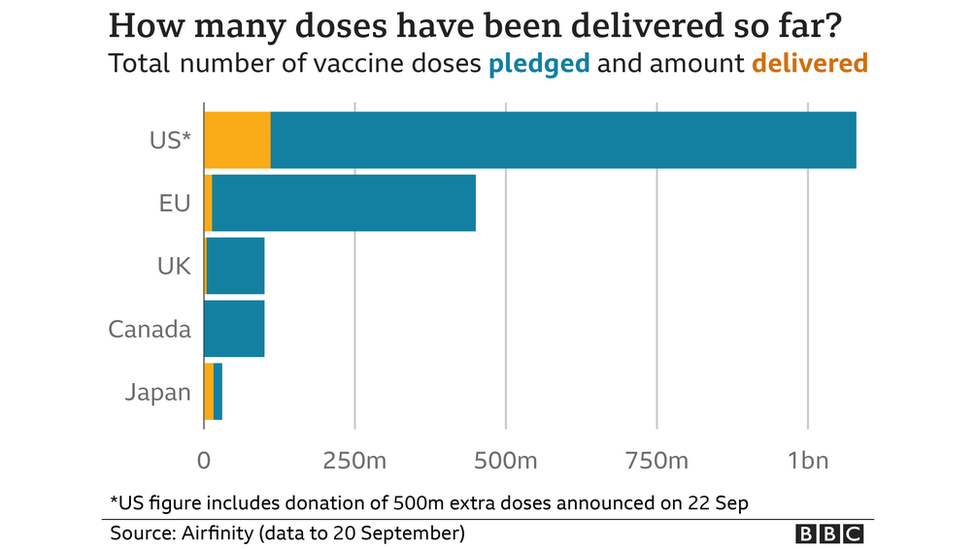
The US had already pledged 580m doses but delivered only 160m of those so far.
So what's different now? Well, global production has picked up in the past few months and there are doses available.
Rich countries could have 1.2bn spare doses by the end of the year, even if they run booster campaigns, according to science analytics firm Airfinity. 241m of those could go to waste if they're not donated. But these need to be sent very soon.
Covax, the WHO-backed scheme to help distribute vaccines fairly, has told the BBC that too many of the donations it's receiving have come in small quantities, at the last minute and with little time left before they expire.
That makes their job of getting them to where they are needed very hard. If Biden want to meet this ambitious goal of vaccinating the world by this time next year, that will have to change.
2px presentational grey lineThe White House's Covid summit comes as research shows rich countries are still holding surpluses of vaccines, many of which could soon be thrown out.
In June, members of the G7 - Canada, France, Germany, Italy, Japan, the UK and the US - pledged to donate one billion doses to poor countries over the next year.
President Biden pledged 580m at the time, of which the US has delivered only 160m so far.
How many doses have been delivered so far?
The donated vaccines are routed through Covax, the global scheme supported by the WHO to get doses where they're needed most.
Covax purchases and then sells vaccines at low-cost to middle income countries and donates to poor countries.
In the US - where more than 76% of adults have received at least one dose - criticism that the country is doing too little to help the rest of the world has grown.
On Friday, a panel advising the US Food and Drug Administration (FDA) recommended booster shots - third doses - of the Pfizer vaccine for people 65 and over.
The WHO has previously called on wealthier nations to hold off on providing boosters until vaccination rates go up in lesser developed countries.

Last week, in a letter to Mr Biden, eight lawmakers of his own party wrote: "Clearly, there is an inequitable distribution of Covid-19 vaccine doses, and it is getting worse."


The US is to donate 500 million more doses of the Pfizer vaccine to developing nations from next year.
 

President Joe Biden made the pledge at a virtual Covid-19 summit on the sidelines of the UN General Assembly, promising an "arsenal of vaccines".
The additional jabs will see the total US commitment on vaccine sharing exceed one billion jabs.
Experts say some 11 billion doses are required to vaccinate at least 70% of the global population.
The World Health Organisation has set a minimum target of 40% vaccine coverage in every country by the end of 2021.
But the goal is unlikely to be met.

While many high-income countries have now given at least one shot to more than half their populations, only 2% of people in low-income countries have had their first dose, according to data from the University of Oxford.